
Selling an investment at a gain can set off a chain of tax questions that aren't always straightforward.
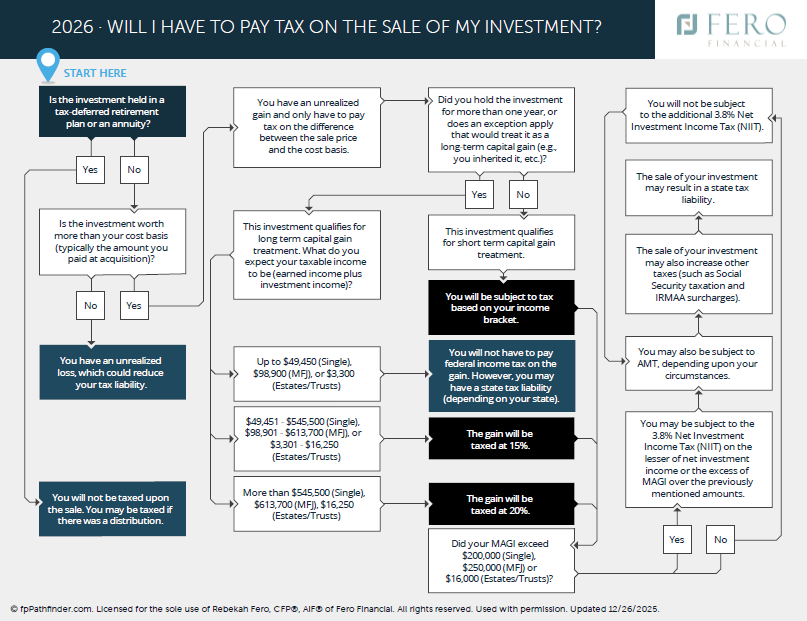
This page explains how capital gains tax on investments is determined for 2026, along with a free downloadable flowchart from Fero Financial built to help you work through the key decision points.
Key Takeaways
- Long-term capital gains treatment applies to investments held for more than one year, bringing significantly lower rates than ordinary income.
- 2026 long-term rates are 0%, 15%, or 20%, depending on your taxable income.
- A 3.8% Net Investment Income Tax (NIIT) may apply when MAGI exceeds $200,000 (single) or $250,000 (married filing jointly), and investment sales can also affect Social Security taxation and Medicare IRMAA surcharges.
- Effective capital gains tax planning weighs timing, account type, and the year's full income picture together rather than treating each sale in isolation.
What Determines Tax on Selling an Investment?
Several factors shape whether the tax on selling an investment applies to your situation and at what rate. The first is the account type.
Assets inside a tax-deferred retirement plan or annuity are not taxed at the time of sale, though distributions from those accounts are generally taxable when taken.
For investments held in a taxable account, the key question is whether the asset has grown above your original cost basis. An unrealized loss, if present, could reduce your overall tax liability rather than add to it.
Short-Term vs. Long-Term Capital Gains
The holding period is one of the most consequential variables in capital gains tax on investments. Assets held for more than one year qualify for long-term treatment, which carries lower rates than ordinary income. Those held for one year or less are taxed at your standard income bracket.
2026 Long-Term Capital Gains Rate Brackets
- 0% for taxable income up to $49,450 (single) or $98,900 (married filing jointly)
- 15% for taxable income between $49,451-$545,500 (single) or $98,901-$613,700 (married filing jointly)
- 20% for taxable income above $545,500 (single) or $613,700 (married filing jointly)
Certain investments may qualify for long-term rates regardless of how long you held them. Inherited assets, for example, often receive this treatment even without meeting the one-year holding period requirement.
Additional Tax Considerations When Selling Investments
Capital gains rates are only part of the picture. If your modified adjusted gross income (MAGI) exceeds $200,000 (single) or $250,000 (married filing jointly), a 3.8% Net Investment Income Tax (NIIT) may apply to the lesser of your net investment income or the amount your MAGI exceeds those thresholds.
Beyond the NIIT, an investment sale may push income high enough to affect the taxable portion of Social Security benefits or trigger higher Medicare IRMAA surcharges. A state tax liability and potential AMT exposure may also apply, depending on your circumstances and state of residence.
2026 Investment Sale Tax Flowchart
Fero Financial offers this decision-support flowchart, prepared by fpPathfinder, to help you work through the factors involved in evaluating capital gains tax on investments. The chart is designed as an educational starting point and should be reviewed alongside a qualified planning professional rather than relied upon as individualized advice.
Download a printable copy of the full resource below.
Download the 2026 Investment Sale Tax Guide (PDF)
This material was prepared by fpPathfinder and does not necessarily represent the views of the presenting party, nor their affiliates. This information has been derived from sources believed to be accurate. Please note - investing involves risk, and past performance is no guarantee of future results. The publisher, Fero Financial, or LPL are not engaged in rendering tax, legal, accounting or other professional services. If assistance is needed, the reader is advised to engage the services of a competent professional. This information should not be construed as investment, tax or legal advice and may not be relied on for the purpose of avoiding any Federal tax penalty. This is neither a solicitation nor recommendation to purchase or sell any investment or insurance product or service, and should not be relied upon as such.
Securities offered through LPL Financial, Member FINRA/SIPC. Advisory services offered through IFG Advisory, LLC, a registered investment advisor, Member FINRA/SIPC. Fero Financial and IFG Advisory, LLC are separate entities from LPL Financial.
Capital Gains Tax Planning With Fero Financial
Capital gains tax planning rarely works in isolation. At Fero Financial, Rebekah J. Fero, CFP®, AIF® integrates investment decisions into a coordinated financial planning strategy, helping clients understand how timing, account structure, and the year's full income picture connect before taking action.
For those approaching retirement with a significant portfolio or navigating an inheritance, having that full picture in view can bring greater clarity to the decisions ahead.
Learn how Fero Financial approaches retirement tax planning, or schedule a free 30-minute conversation to discuss how capital gains tax on investments may factor into your financial picture.