
Key Takeaways
- Recessions and bear markets describe two different aspects of economic downturns. A recession affects the overall economy, while a bear market refers to significant declines in the stock market.
- No two recessions or bear markets are exactly alike, so historical data cannot provide an exact timeline for when the next downturn will end.
- Historically, recessions in the U.S. have been shorter than expansions; investors should avoid selling during a downturn, as it can lead to losses and create additional risks when trying to buy back their investment.
- Looking at the broader market cycle can give investors a better sense of where recessions and bear markets fit over time.
As markets decline and economic activity starts losing momentum, it is common to question how long the downturn might last. Particularly when the news is mostly filled with stories about the recession and declining markets, one can feel like the downturn has been going on forever, especially if you’re watching your retirement savings and investments lose value.
So, in actuality, how long do recessions last? Given that market movements are cyclical, looking at past behavior can put these periods into perspective.
Generally, although recessions and bear markets can put pressure on investors and cause uncertainty, they’ve typically been followed by longer stretches of economic growth and market gains.
Let’s explore this further.
What Is a Bear Market?
The term bear market refers to when a broad market index falls by 20% or more from a previous high. Unlike a bear market, a recession refers to the substantial slowdown or decline in overall economic activity. Although the two may overlap, they describe entirely different things.
A recession affects the broader economy, including areas such as jobs, production, income, and consumer spending. A bear market involves falling investment prices.
Understanding this distinction can help you better interpret market headlines. You can understand market activity, decipher how long bear markets and recessions last, and schedule your investments with these timelines in mind.
How Long Do Recessions Last?
No two recessions have had the same timeline. Some have ended within a few months, while others have stretched on much longer.
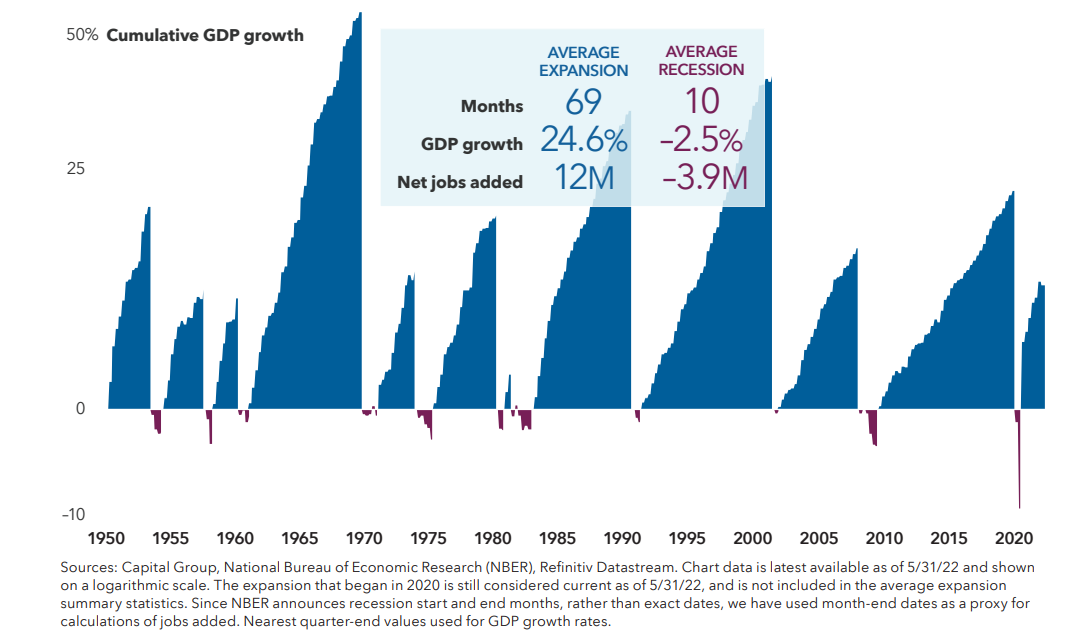
The historical data chart covering U.S. expansions and recessions from around 1950 through 2022 above shows an important pattern: expansions have generally lasted longer than recessions.
Over the last 70 years, the U.S. has been in an official recession in fewer than 15% of months, and the net long-term economic impact of these recessions has been relatively small. During expansion, cumulative GDP growth was about 24.6%, compared with a roughly 2.5% decline during the average recession on the chart.
Although recessions have been painful, with job losses, reduced business activity, and uncertainty, these have been relatively small dips in economic history. Looking at the full economic cycle, expansion has been more powerful.
How Long Do Bear Markets Last?
For investors in retirement worried about the effect of bear markets on their savings and investments, the answer to this question is that there’s no predetermined timeline for a bear market.
Some market downturns have been short-lived, while others have taken much longer to recover from.
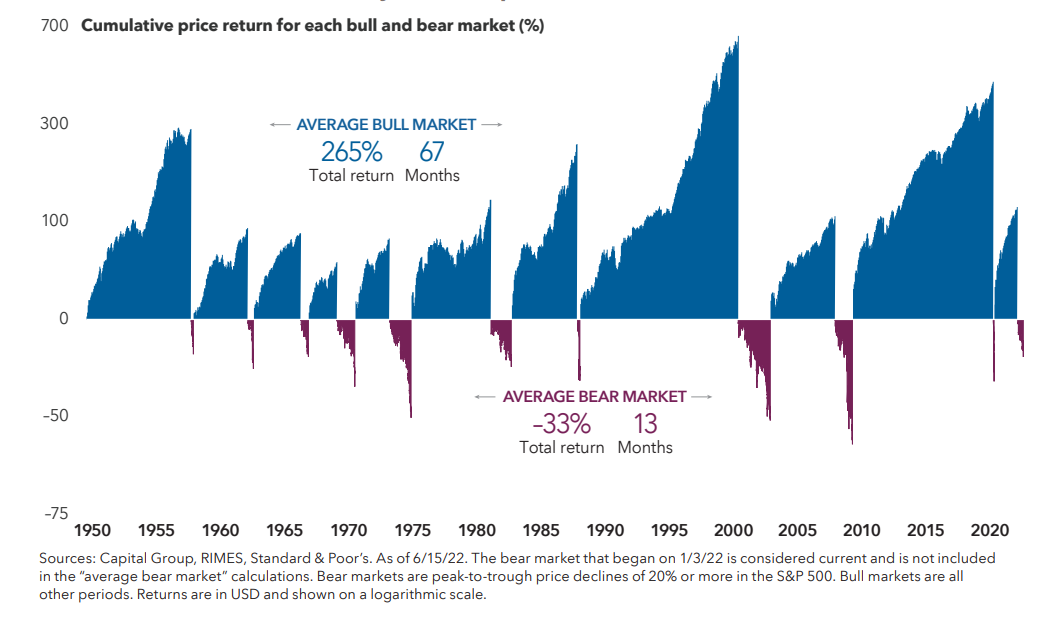
From the chart above, spanning 1950 to 2022, the average bear market lasted about 13 months, with an average peak-to-trough decline of approximately 33%. Additionally, the graph shows that the average bull market lasted about 67 months and generated a cumulative return of approximately 265% over the periods shown.
These figures do not predict how long you can expect a bear market to last; they demonstrate that just by looking at a single downturn without looking back at bear markets in history and the longer market cycle, you won’t have a complete picture of how the market works.
What Does Bear Market Recovery Look Like?
It is important to note that bear markets do not typically have neat recoveries. The market can rise, fall again, and even fluctuate for a bit before finding its way back up. This is the reason why market timing is often difficult.
Investors are warned that selling an investment because it has fallen sharply during a decline can turn a temporary drop in value into a permanent loss. Besides, liquidating your asset during a downturn creates another problem of not knowing when to get back into the market.
Investing During a Recession
Given the market trends during a decline, and without clarity about how long a bear market will last, how can you go about investing during a recession?
Take an approach that accounts for your age, income needs, cash savings, investment horizon, and long-term financial goals. An individual who’s decades away from retirement may have time to wait through market fluctuations, while someone about to retire will need a different approach for managing their assets.
That’s the reason why a downturn presents an opportunity to review your financial plan. With the help of a financial planner, revisit your cash reserves, income strategy, investment allocation, and upcoming financial needs.
Navigate Recessions and Bear Markets With Fero Financial
Facing a recession or bear market can be challenging, but you don’t have to navigate it alone.
At Fero Financial, we help clients take a broader view of their finances and make decisions that align with their goals, timelines, and unique financial situations, rather than basing them on short-term market movements. Through Holistic Financial Planning, we help ensure your overall financial plan stays aligned with your financial goals and retirement plans during periods of market volatility.
Rather than trying to predict how long a bear market will last, we focus on building a financial plan to help you navigate different market conditions with greater clarity and confidence.
Are you ready to take a closer look at your financial plan with the help of a financial planner? Call Fero Financial today.
FAQs
How often do bear markets happen?
Bear markets are a normal part of long-term market cycles, but they don’t follow a set schedule. Their frequency can vary depending on the time period and market index being considered.
Do stock markets recover after every bear market?
Historically, broad stock markets have bounced back from past bear markets, but the timing and pace of those recoveries have varied. Keep in mind that past performance does not guarantee future results.
Can a bear market happen without a recession?
Yes, the stock market can experience a bear market even when the rest of the economy has not gotten into a recognized recession.
Can a recession happen without a bear market?
Yes, it can. Although recessions can negatively affect corporate profits and stock prices, not every recession is accompanied by a 20% decline in the broader market.
NOTE: The opinions voiced in this material are for general information only and are not intended to provide specific advice or recommendations for any individual. All performance referenced is historical and is no guarantee of future results. All indices are unmanaged and may not be invested into directly.